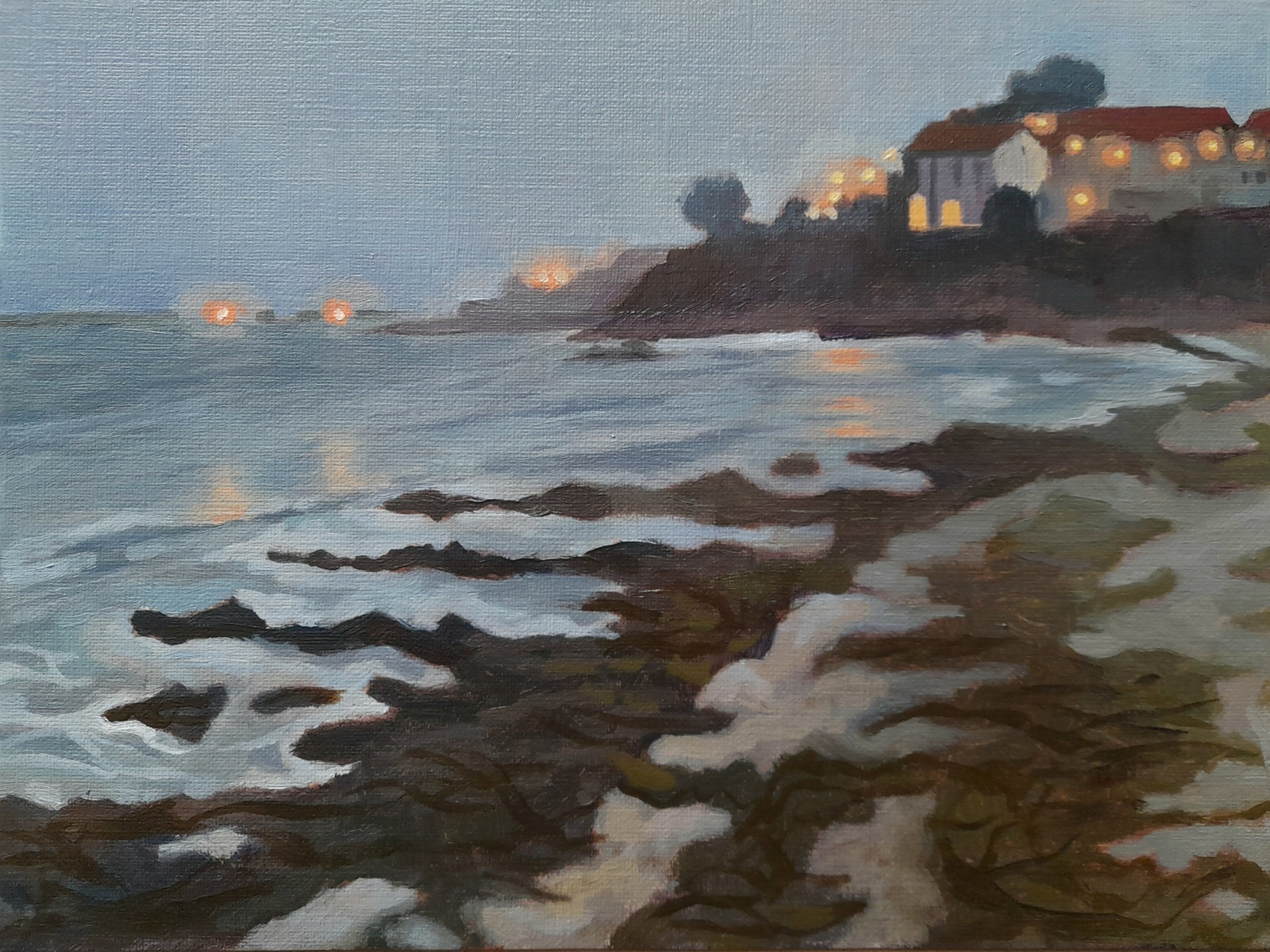
Today in Galicia, the rain covers everything with its characteristic melancholic veil. Perhaps the rainy season has already begun, and this weather invites me to stay at home, dedicating myself to small landscape compositions. I use as a basis my photographs, which I have accumulated in abundance over the seasons and at different times of the day. Each image captures a unique moment, but what attracts me most is that mysterious and symbolic atmosphere created by the half-light filtered by the fog, the snow-white waves of the sea that furrow the sea and then crash against the dark rocks, the colour caused by the setting or rising sun on the surface of the sea or in the clouds, or the contrast between the grey clouds and the intense green of the Galician landscape.
As I paint, I think about how this passion for capturing nature and its atmosphere has been part of the history of art for centuries.
A brief history of landscape painting
Although the depiction of landscape appears in ancient civilisations, such as in Egyptian and Roman wall paintings, landscape as an independent genre began to develop in the Renaissance. Artists such as Leonardo da Vinci and Albrecht Dürer incorporated it into their works, although generally as a background for religious or mythological compositions.
It was in the 17th century that landscape painting achieved its autonomy, particularly in Dutch painting. Artists such as Jacob van Ruisdael captured the essence of nature in scenes in which light and weather were the protagonists. A little later, in England, J.M.W. Turner and John Constable brought the landscape to the forefront. Turner and John Constable took landscape to new heights, experimenting with light, movement and the emotions that nature could evoke.
In the 19th century, the French Impressionists, such as Claude Monet, revolutionised landscape painting with their focus on changing light and colour. This impulse continued with artists such as Joaquín Sorolla, master of Mediterranean light, and John Singer Sargent, whose landscape watercolours are true studies of movement and atmosphere. I am also fascinated by Paul Gauguin, with his expressive use of colour and his ability to turn landscapes into almost mythical settings.
Contemporary landscape artists
Today, landscape painting is still alive and evolving. I have discovered contemporary artists I admire through Instagram, such as Jesse Powell, with his vibrant marine scenes; Jeremy Miranda, who combines the dreamlike with the everyday; Josh Clare, whose landscapes evoke an almost palpable serenity; Colley Whisson, with his free and lively brushstrokes; and Jennifer McChristian, who masterfully captures the light and details of everyday life.
They, along with other contemporary artists, carry forward the tradition of exploring the relationship between humans and nature, but with fresh perspectives and innovative techniques.
The connection with my environment
On this rainy day, as I transform my photographs into small paintings, I feel like I am building the foundations of something bigger. With the arrival of spring, I dream of going out and painting en plein air, of feeling the wind on my face as I capture the light and colour directly from the landscape.
I'm still a bit embarrassed to go out, I feel I'm not quite ready. But I know that these exercises at home are helping me to improve, step by step. That's my resolution for this year 2025: to overcome that fear and connect with the outside world through my brush.
What is your big creative dream?