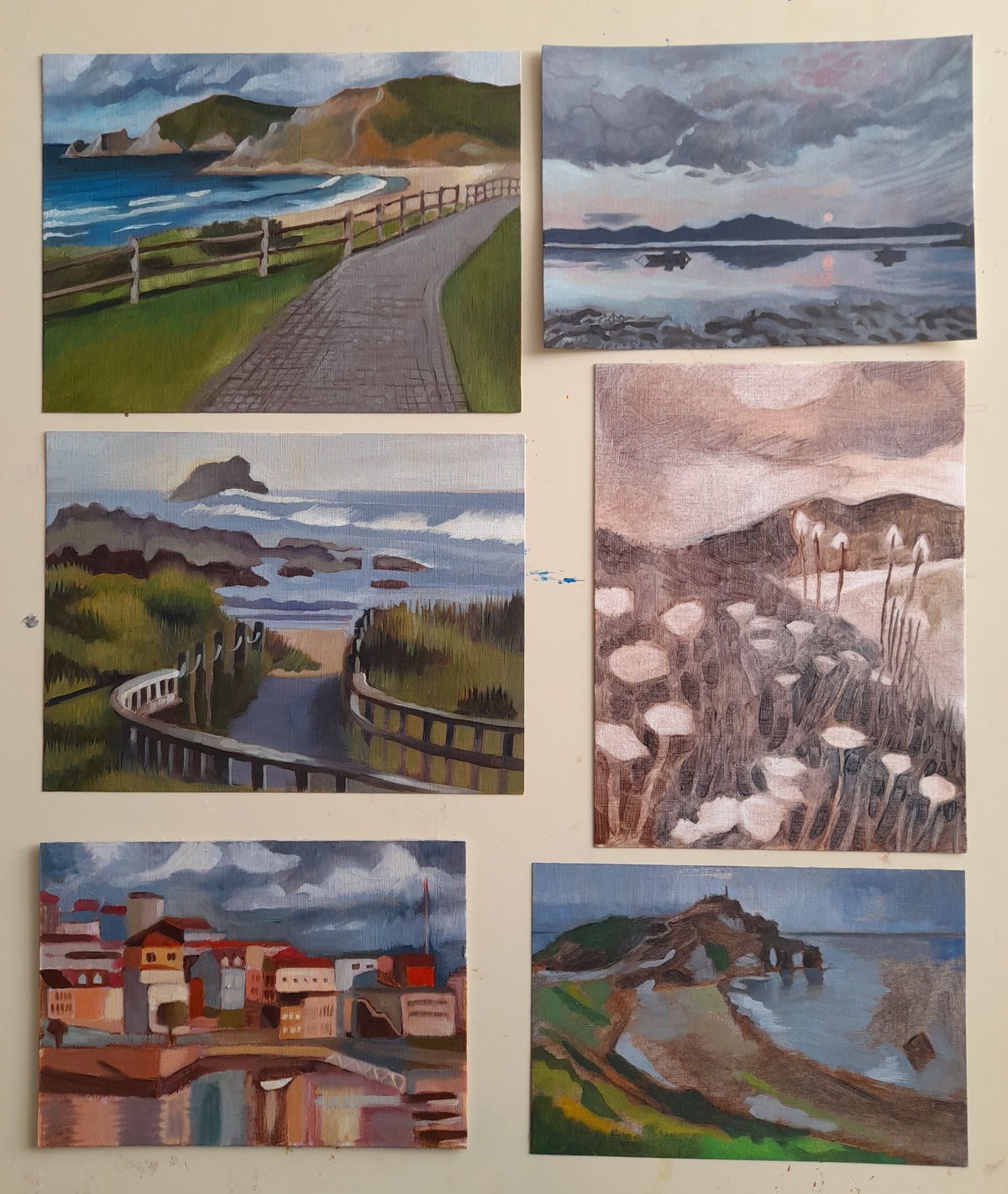
This January I have decided to devote myself to studying landscapes, a subject that has captured my interest for many years. My focus is on the landscape of Finistère, a place that has become my home for the past seven years. In this time, I have had the opportunity to capture special moments with my camera: sunrises, sunsets, moonrises, and, of course, those mystical atmospheres that are created when the mist covers the horizon. These photographs have become the basis for my small oil studies, made in A5 and A4 formats. Each brushstroke is an attempt to transfer to canvas the essence of what I have experienced here, transforming the ephemeral into something tangible.
Landscape in the History of Art
Throughout the history of art, landscape has played a crucial role in both the depiction of nature and the emotional exploration of the environment. Although landscapes began as mere backgrounds in religious or mythological scenes, artists soon began to treat landscape as an autonomous subject. During the Renaissance and Baroque periods, landscapes were incorporated into many works to give them context and depth, but it was in the 19th century that landscape began to take centre stage.
I am particularly attracted to three periods in the evolution of landscape painting: Impressionism, Post-Impressionism and Modernism. These movements revolutionised the way we perceive and represent nature.
- ImpressionismThe Impressionists broke with the academic conventions of painting. Artists such as Claude Monet, Camille Pissarro and Édouard Manet began to paint outdoors, directly from nature. Their interest was not in precise detail, but in capturing light, colour and atmosphere at the exact moment. Quick brushstrokes and vibrant colours brought landscape scenes to life with a freshness never seen before.
- Post-ImpressionismArtists such as Vincent van Gogh, Paul Cézanne and Georges Seurat took the work of the Impressionists further, delving into form and structure. Van Gogh, with his whirlwind brushstrokes and intense colours, and Cézanne, with his interest in geometry and form, opened the way for new ways of seeing and representing landscapes.
- ModernismIn the late 19th and early 20th centuries, Modernisme in Catalonia stood out as a unique and vibrant movement. The notable Catalan school, with artists such as Ramon Casas, Santiago Rusiñol, Alexandre de Riquer, Adrià Gual, Joan Llimona, Isidre Nonell and Joaquim Mir, created a rich tradition of landscapes that fused the beauty of nature with the emotionality of their time. These artists used landscape not only as a natural subject, but also as a means of expressing the tensions and social transformation of the time, as well as their personal concerns. Mediterranean light, vibrant colours and evocative compositions characterise their works, which continue to be a great source of inspiration.
A Journey of Continuous Learning
Although I have been deeply influenced by these movements, my personal process as an artist is still in constant evolution. Currently, I am still learning the techniques of oil painting, a medium that allows me to explore different forms of expression and to work with a wealth of textures and colours. I am discovering, little by little, the different ways to use it, and as I progress, I am delving deeper into specific techniques that allow me to bring my landscapes to life in a more expressive and detailed way.
In my next post, I will talk about some of the techniques I am exploring: thin layer or glaze, impasto, grisaille, wet-on-wet painting, enamel, dry brush and sfumato. Each of these techniques offers new possibilities for the artist, and I am excited to continue learning and sharing this journey with you.
Thank you for joining me in this process of discovery, and I hope that my landscape studies will continue to inspire as much as they inspire me on a daily basis.